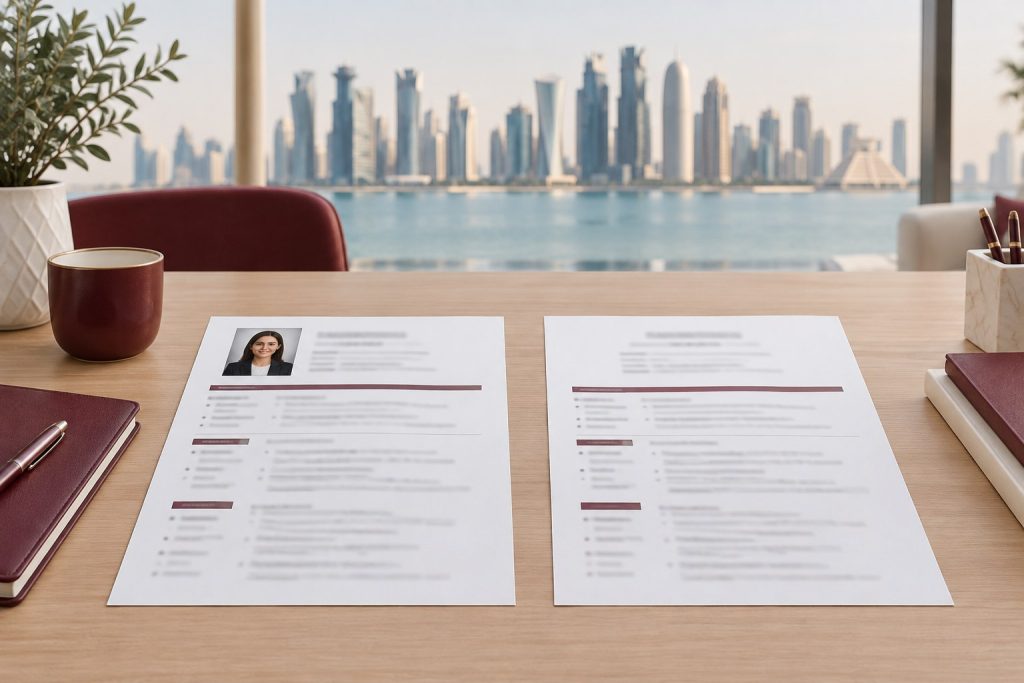
One Qatar CV template has a headshot beside the name; another has no picture at all. Which should you send? A CV photo is not automatically required for jobs in Qatar. Start with the vacancy’s instructions, then consider how the employer receives applications. A template’s empty photo box is not an instruction from a recruiter.
If the employer says nothing about photographs, a clear CV without one is a sensible starting point. Your decision should protect the space and attention needed for your qualifications, experience and results.
Should You Put a Photo on Your Qatar CV? The Short Answer
A photograph is not a standard requirement for every Qatar application. Follow the employer’s instructions: a requested image may belong on the CV, in a separate upload field or with recruitment-event documents. When no photo is requested, a readable, photo-free CV can be appropriate. The role and application process matter, but neither proves that appearance improves hiring chances. If you include a headshot, keep it current, professional and small enough that your relevant experience still leads.
Is a Photo Required on a CV in Qatar?
There is no universal Qatar rule that every job seeker must put a photograph on a CV. This practical guidance concerns CV presentation; separate identity, visa or onboarding procedures have their own requirements. Do not confuse a photograph requested later for official paperwork with a photograph needed on your initial application.
Required: the employer asks for it
A vacancy might request a CV with a recent photograph. Another might ask for a separate image. Read the exact wording and use the requested channel. If it is unclear, ask whether the picture should be embedded or attached separately.
Common: you have seen others use it
Photographs appear in some candidate CVs and recruitment templates. That observation does not establish how frequently Qatar employers expect them, or whether the employer you are approaching does. A colleague’s successful application is one example, not evidence of a nationwide requirement.
Optional: the instructions are silent
If there is no request, you can usually leave the picture out. Do not assume a CV without one looks unfinished. An optional CV photo is a presentation choice, not proof of competence. Conversely, an optional photograph does not automatically make an otherwise clear document unsuitable. Judge the actual file and recruitment process.

Qatar CV Photo Decision Matrix
| Your situation | Practical choice | What to check |
|---|---|---|
| Employer requests a photograph on the CV | Include a suitable headshot as instructed | Placement, image specifications and authenticity of the request |
| Portal asks for a separate picture | Use that upload field | Whether the field is mandatory; do not duplicate it unless asked |
| Corporate office, accounting, procurement or administration role | A photo-free CV is a reasonable default | The particular employer’s instructions |
| Engineering, construction, IT or technician role | Prioritise technical evidence; a picture is usually optional unless requested | Required skills, licences and project information remain visible |
| Sales, hospitality or another customer-facing role | Check rather than assume a photo is expected | Vacancy-specific or event-specific requirements |
| Healthcare application | Lead with qualifications and relevant clinical experience | Keep credential or identity uploads separate where requested |
| Fresh graduate | No photo is needed merely to fill space | Education, internship and project evidence |
| Supervisor, manager or senior professional | Keep leadership evidence prominent | An optional image does not displace achievements |
| Application that extracts CV details automatically | Prefer a simple text-focused document | Parsed fields and the system’s guidance |
| Public CV database | Consider omitting unnecessary personal information | Visibility, sharing settings and privacy notice |
These are practical considerations, not official rules for Qatar employers. Follow the specific vacancy and application instructions.
When Might Including a CV Photo Make Sense?
The strongest reason is a clear request from a verified employer or a recruitment agency handling an identifiable vacancy. Similarly, a dedicated portal field is another reason to have a suitable image ready, although an optional field remains optional. Some recruitment events have their own document checklist.
Customer-facing work does not create an automatic exception. A hotel receptionist, sales executive and cabin crew applicant may encounter different procedures, even within the same sector. For aviation applications, use the airline’s official vacancy or event instructions instead of applying a rule from an unrelated role.
Having a good headshot makes including one easier, but it does not establish a hiring advantage. Communication, service experience and professional judgement are demonstrated through your record and selection process. Therefore, a photograph cannot substitute for those skills.
When Can You Leave the CV Photo Off?
Leaving it off is reasonable when no photograph is requested, when the employer asks for a plain CV, or when you want to limit unnecessary personal information. It is also useful when the picture forces your skills or current job further down the page.
A poor-quality photo is not an improvement over no photo. If the image is optional and the only available choice is a cropped party picture, submit the stronger document without it. If a suitable image is required, take a fresh photograph rather than trying to rescue an unsuitable one.
For engineers, accountants, office professionals and graduates, the decision is the same: read the instructions first. Your profession does not require a photo simply because you are applying in Qatar. Likewise, overseas applicants can use the same approach.
CV Photo vs No-Photo Comparison Table
| Decision factor | CV with a photograph | CV without a photograph |
|---|---|---|
| Employer explicitly requests an embedded photo | Can fulfil the instruction | May leave the application incomplete |
| Space for relevant experience | Needs careful sizing and placement | Leaves more space for professional evidence |
| Automated parsing | Image and surrounding layout can introduce problems in some systems | Removes one possible formatting complication |
| Personal information shared | Includes visual information beyond the work record | Limits that additional disclosure |
| Presentation quality | Depends on the image and document layout | Depends on typography, structure and content |
| Evidence of job suitability | Still needs qualifications, skills and achievements | Still needs qualifications, skills and achievements |
Neither format guarantees an interview. If applications are going unanswered, review your match to the vacancy before treating the missing picture as the explanation. Our guide to why Qatar job applications get rejected examines more useful checks.
“Should I Add a Photo?” Decision Tree
- Does the employer say not to include one? Yes: leave it off. No: continue.
- Does the employer ask for a photo? Yes: check whether it belongs on the CV or in a separate field. Follow that instruction.
- Are the instructions unclear? Ask the employer or verified recruiter before preparing several versions.
- No request, and the application parses your CV? Use a simple photo-free version as your starting point.
- No request, and you are considering an optional image? Check its quality, privacy implications and effect on readability. If it adds clutter or you would rather not share it, omit it.
This process gives you a decision you can explain. As a result, it avoids choosing a photograph only because a downloaded template contains a placeholder.
Does a Photo on a CV in Qatar Affect ATS?
An applicant tracking system may store the file and extract information into candidate fields. However, parsing and selection are different tasks. A parsing problem does not, by itself, prove that the candidate has been rejected.
Greenhouse’s resume-parsing guidance identifies photos and graphics among possible formatting problems. In addition, it lists columns and complex layouts. This supports choosing a simple document; it does not mean every ATS rejects every photograph.
If a photo is required, keep the CV’s name, contact details, work history and qualifications as real text. Do not submit a screenshot of the entire CV. Next, use the accepted file type, inspect the upload preview and correct any fields the portal fills incorrectly.
A separate photo field lets you provide the image without adding it to the CV, unless both are requested. For more on readable files, see how to make your Qatar CV ATS-friendly.
What Type of CV Photo Should You Use?
Choose a recent, recognisable head-and-shoulders photograph with even lighting and an uncluttered background. Wear clothing appropriate for a professional application without trying to imitate an appearance stereotype. A natural smile or a neutral expression can both work.
A simple photograph taken with a phone can be sufficient. Stand facing soft light, keep the camera around eye level and ask someone to take several frames. Then, check the result at the size it will appear in the document. You do not need expensive studio photography for an optional CV image.
Professional Photo Checklist
- The photograph is recent and looks like you.
- Your face is clear, in focus and not obscured by harsh shadows.
- The background is plain or visually quiet.
- The framing includes your head and shoulders without cutting awkwardly.
- No other person, distracting object or event badge appears.
- There are no beauty filters or edits that change your appearance.
- The image remains clear after compression.
- You meet any stated size, background and file-format requirements.
A LinkedIn headshot can work if you have the original image and it meets these checks. A passport-style photograph may also be suitable. However, a request for a passport-size photo means an image of you, not a copy of your passport’s identity page.
Good and Poor CV Photo Choices: Practical Examples
Good choice: a recent headshot against a plain wall, with even light, ordinary professional clothing and enough resolution for a small CV image. It looks like the applicant and leaves the page easy to read.
Poor choice: a wedding group photo cropped so tightly that part of another person remains visible. The problem is the distracting context and poor crop, not the applicant’s appearance.
Another poor choice: a heavily filtered selfie or a full-body holiday picture reduced to a tiny box. Neither is necessary when a clear headshot can be taken easily.
Do not generate a replacement face or use AI to change your age, skin tone or facial features. Light adjustment, rotation and sensible cropping can improve a genuine image without misrepresenting you. “Professional” should describe clarity and context, never attractiveness, ethnicity or gender.
What If the Employer Specifically Requests a Photo?
Consider this fictional scenario: an applicant receives a verified recruiter’s message asking for a CV and a recent passport-size photograph for a named vacancy. The original advert did not mention a photograph.
The applicant first confirms the recruitment agency and vacancy, then asks: “Would you like the photograph as a separate attachment or included in the CV? Please confirm any size or background requirements.” This resolves the practical uncertainty without assuming the CV must be redesigned.
If the recruiter requests a separate JPG, send that file and keep the CV unchanged. Use a clear filename such as Amina_Rahman_Photo.jpg. Before sending, check the attachment. However, do not add identity documents merely because a photo was requested.
If you prefer not to provide an optional photograph, ask whether it is necessary to proceed. If it is stated as mandatory, clarify the requirement and decide whether you wish to continue. Do not assume either that refusal has no consequences or that every request is suspicious.
Privacy and Bias: What Does a Photograph Add?
A headshot provides visual information that may be unnecessary for evaluating your professional suitability. Once uploaded, it may be stored with your candidate profile or shared within a recruitment process. Therefore, the trade-off depends on who receives it and how the service handles applications.
For public CV uploads and third-party databases, check visibility settings and the privacy notice. Look for information about access, sharing, retention and contact details. Ask the recruiter about intended use if the request is unclear. Qatar’s National Cyber Security Agency publishes personal data privacy resources; those resources are separate from an employer’s application instructions.
A photo is not inherently unsafe, and omitting it does not remove every privacy concern. Your name, employment history and contact information also require sensible handling. For this reason, share what the legitimate application needs through a verified channel.
Photographs can also introduce visual cues that may influence judgement unrelated to competence. Fair recruitment should focus on qualifications and job-relevant evidence. No candidate should be encouraged to look younger, lighter-skinned, wealthier or more like a preferred nationality. The same decision process applies to men and women.
Should Overseas Candidates Add Personal Details Beside the Photo?
Applying from India, Pakistan, Nepal, the Philippines, Europe or elsewhere does not create a separate photo rule. Follow the employer’s instructions, not advice based on nationality. State your current city and country where useful; do not use a photograph to imply that you already live in Doha.
A photo is not a reason to add age, religion, marital status, ethnicity, passport number or a detailed home address. Nationality and work-authorisation information may be requested separately in an application process. Answer relevant verified questions accurately without turning the CV into an identity-document summary.
If an employer needs a particular eligibility detail, provide the requested factual information in the appropriate field. Keep immigration or onboarding paperwork distinct from the initial CV wherever the process allows.
Keep the Photo from Taking Over the Page
If you use a photo on a CV in Qatar, check the exported document on a phone as well as a larger screen. Your name, profession, contact details and recent experience should remain easy to find. An oversized portrait should not push your current role onto another page.
Keep the image small and avoid wrapping narrow columns of text around it. Check that it has not distorted, moved over a heading or created a mostly empty extra page during export. Finally, select and copy the CV text to confirm that the document still contains real text.
If removing the photograph restores readable spacing, that is a useful reason to leave an optional image out. For the broader space decision, see choosing a one-page or two-page CV for Qatar jobs.
Before-Submission Checklist
- Have I checked the advert and portal instructions?
- Is the photograph required, optional or requested separately?
- Have I verified an unexpected recruiter request?
- If included, is the photo recent, clear and accurate?
- Do my qualifications and experience remain prominent?
- Does the exported file look readable on a phone?
- Have I checked the portal preview and any extracted fields?
- Have I avoided unnecessary identity documents and personal details?
- Have I checked the audience and privacy settings for a public upload?
- Am I sending the correct version for this particular vacancy?
Choose the Format the Application Actually Needs
You do not need a photo to make a CV complete when the employer has not requested one. If a photograph is required, provide an accurate image in the right place and keep the work record readable. When the choice is optional, clarity, privacy and useful space give you better reasons than habit.
Compare the instructions in suitable Qatar job vacancies, then prepare that version of your application. If you need help arranging the content, use the Gulf Career Group resume builder and check the final export before submitting.
Related articles

How to Write a Professional WhatsApp Message to a Recruiter in Qatar
A practical guide to a short, specific WhatsApp note for a recruiter in Qatar: when to write, how…
By Gulf Career Group · 35 min read
One-Page or Two-Page CV? What Works Better for Jobs in Qatar
A Qatar job CV can be one page or two, depending on experience and the evidence you need.…
By Gulf Career Group · 21 min read
How to Make Your CV Pass ATS Screening for Qatar Jobs
ATS screening for Qatar jobs needs a simple text CV that matches the advert. Skip columns, scans and…
By Gulf Career Group · 20 min read
Why Recruiters View Your CV but Never Call — 8 Possible Reasons
Recruiters view your CV and still do not call for eight ordinary reasons. Fix the match, the number,…
By Gulf Career Group · 20 min read