
Return to Work in Qatar After a Career Break
Return to Work in Qatar after a career break with a clear plan that focuses on previous experience, current skills and readiness for employment. However, a career gap does not automatically prevent you from building a successful career in Qatar. Many employers will also consider your qualifications, communication skills and ability to contribute.
Whether the break was related to family responsibilities, relocation, education, professional development or a planned period away from employment, preparation can make the process easier. Therefore, this guide explains how to update your CV, refresh important skills, rebuild professional connections, prepare for interviews and search for suitable opportunities.
Most importantly, explain the employment gap honestly and focus on vacancies that match your background. In addition, check current employer, licensing and labour requirements before making important career decisions.
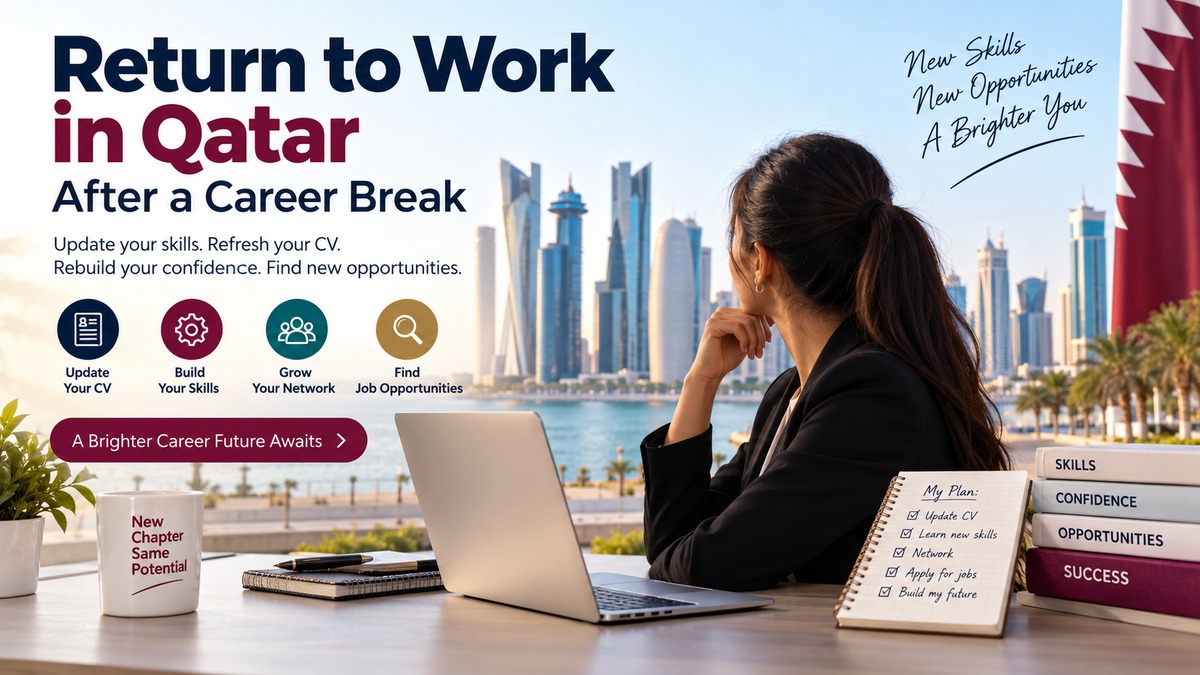
Return to Work in Qatar: Where to Start
Before applying for jobs, assess your current situation. Although your previous job title matters, it should not be the only factor that determines your next move. Instead, review the experience, skills and achievements that remain relevant in today's job market.
Consider the following:
- Previous roles and major professional achievements
- Transferable skills that remain valuable
- Current qualifications and industry knowledge
- Technical or digital skills that may need updating
- Interest in returning to the same profession
- Possibility of moving into a related career
- Preferred working hours and employment arrangements
- Realistic salary expectations
- Industries and employers you want to target
In addition, consider how your previous experience fits current market requirements. A career restart does not always mean returning to exactly the same role you held before the break. For example, a former project coordinator may move into planning, documentation, administration or client coordination if those areas better match current skills and opportunities.
How to Explain a Career Break Professionally
Employers may ask why you were away from full-time employment. Therefore, prepare a short and factual explanation before attending interviews.
The purpose is not to provide every personal detail. Instead, explain the career break clearly and then move the discussion back to your professional experience and readiness to work.
Common reasons for employment gaps can include:
- Family responsibilities
- Childcare
- Relocation
- Education
- Professional training
- Personal development
- A planned period away from full-time employment
For example, you could explain that you took a planned break for family responsibilities, remained connected to your profession and are now ready to return to full-time work.
Alternatively, if relocation caused the gap, explain that you temporarily stepped away from employment during the move and used part of the period to update your skills.
Above all, remain truthful. Do not invent employment dates, positions, projects or qualifications simply to hide an employment gap.
How to Prepare Your CV to Return to Work in Qatar
A CV that worked several years ago may no longer present your experience effectively. Therefore, update the document before submitting new applications.
Review the following areas:
- Current phone number and professional email address
- Professional summary
- Previous achievements
- Recent training and certifications
- Current software and technical skills
- Industry terminology used in current vacancies
- Outdated information that can be removed
- Overall formatting and readability
Whenever possible, describe achievements rather than listing only routine duties. For example, instead of saying that you were responsible for suppliers, explain that you managed supplier coordination, negotiated contracts or helped reduce procurement delays.
How to Show a Career Break on Your CV
If your CV clearly shows a long employment gap, it can be useful to include a short career-break entry.
Career Break | 2023–2025
Took a planned break for family responsibilities while maintaining professional knowledge and completing relevant training before returning to full-time employment.
Another example is:
Professional Development Break | 2024–2026
Focused on technical upskilling, certification and preparation for re-entry into the workforce.
Keep the explanation brief. Moreover, avoid apologizing for the gap or providing private information that is not relevant to the job.
Example Professional Summary
Experienced procurement professional with eight years of GCC experience returning to full-time employment after a planned career break. Skilled in strategic sourcing, contract negotiation, supplier management and cost control, with recent training in ERP systems and procurement planning.
Finally, tailor your CV to each suitable vacancy rather than sending exactly the same document to unrelated employers.
Skills You Need to Return to Work in Qatar
Moreover, recent learning can help demonstrate that you are prepared for today's workplace. However, collecting many unrelated certificates is unlikely to improve your application. Instead, identify the skills that genuinely matter in your profession.
Depending on your career, useful areas may include:
- Microsoft Excel
- Microsoft Office applications
- ERP systems
- Project-management tools
- AI and productivity tools
- Industry-specific software
- Communication skills
- Professional certifications
- Technical certifications
- Health and safety training
- Current industry standards
For example, an accountant may need current knowledge of ERP systems and reporting tools. Meanwhile, an engineer may need updated technical software, project-management knowledge or familiarity with newer standards. Therefore, choose training that has a clear connection to the jobs you plan to pursue.
Check Professional Licensing and Registration Requirements
Some professions in Qatar may require current registration, licensing, credential verification or employer-specific approvals.
This can apply to areas such as:
- Healthcare
- Engineering
- Education
- Certain regulated technical professions
In addition, requirements can change and may differ according to profession. Therefore, do not rely only on information you received several years ago. Instead, check the latest requirements with the appropriate authority or employer before applying for a regulated position.
For general employment and labour information, candidates can visit the Qatar Ministry of Labour.
How Networking Can Help You Return to Work in Qatar
Similarly, a career break can reduce your day-to-day contact with former colleagues, managers, suppliers and clients. Therefore, reconnecting with professional contacts can be an important part of your career restart.
Useful steps include:
- Contacting trusted former colleagues
- Reconnecting with previous managers
- Updating your LinkedIn profile
- Following employers in your industry
- Joining relevant professional groups
- Attending suitable industry events
- Participating in useful professional discussions
However, networking should remain professional and relationship-based. Instead of contacting someone only to say, "I need a job," briefly explain that you are returning to employment and mention the type of role you are targeting. In addition, former colleagues may help you understand how your industry has changed during your career break.
Use LinkedIn to Support Your Career Restart
Your LinkedIn profile should support the information contained in your CV. Therefore, check that employment dates, job titles, qualifications and professional skills are consistent.
Useful updates include:
- A clear professional headline
- An informative About section
- Accurate employment history
- Career-break information where useful
- Recent certifications and training
- Relevant professional skills
- Recommendations where appropriate
- A professional profile photo
For example, a suitable headline could be:
Project Coordinator | 7 Years GCC Experience | Returning to Work | Planning, Documentation & Client Coordination
However, avoid making the employment gap the main focus of the profile. Instead, give greater attention to your experience, skills and future career direction.

Return to Work in Qatar: Interview Preparation
Interviewers may ask about your employment gap. Therefore, practise answering this question before the interview so that your response is clear and professional.
Example Answer for Family Responsibilities
"I took a planned career break for family responsibilities. During that period, I remained connected to my field and recently completed training to update my skills. I am now ready to return to full-time work and am focusing on roles that match my previous experience."
Example Answer for Relocation
"I stepped away from full-time employment during a relocation period. During that time, I updated my skills and reviewed developments in my industry. I am now settled and ready to return to work."
Keep your answer brief. Then, move the conversation toward your achievements, experience, recent training and ability to perform the job.
Common Interview Questions After a Career Break
Why Did You Take a Career Break?
Give a truthful and concise explanation. There is usually no need to disclose private information that does not affect your ability to perform the job.
Why Are You Returning to Work Now?
Explain that you are ready to return to employment and describe the type of position you are targeting. In addition, show that your decision has been planned carefully.
How Have You Kept Your Skills Current?
Mention relevant courses, professional reading, software practice, certifications, training or other genuine activities completed during or after the break.
Are You Ready for Full-Time Work?
Answer according to your actual availability. If you are applying for a full-time position, the employer will normally expect you to meet the working requirements of that role.
What Salary Are You Expecting?
Research current salary levels for your profession and experience. However, compare the complete employment package instead of looking only at basic salary.
Should You Accept a Lower Position After a Career Break?
Not every returning professional needs to restart at entry level. In fact, your previous experience can remain valuable when your professional skills are still current.
However, a different or slightly less senior position may sometimes provide a practical route back into the job market.
Consider:
- The length of your career break
- How much your industry has changed
- Previous level of seniority
- Current technical skills
- Financial requirements
- Quality of the employer
- Training opportunities
- Future promotion possibilities
For example, a former manager may accept a senior specialist or coordinator role if it provides valuable market exposure and a realistic path back to leadership.
Should You Accept a Lower Salary After a Career Break?
A career break does not automatically mean you should accept a lower salary. Instead, research the current market value of your experience and skills.
When comparing employment offers, consider:
- Basic salary
- Housing or accommodation
- Transportation
- Medical insurance
- Working hours
- Career progression
- Training opportunities
- Employer reputation
- Overall employment package
If market conditions have changed significantly during your career break, your expectations may also need to change. Nevertheless, base that decision on current market evidence rather than assuming that an employment gap automatically reduces your professional value.
How to Find Jobs and Return to Work in Qatar
Meanwhile, a structured job search can help you avoid wasting time on unsuitable vacancies. Therefore, begin with a realistic list of job titles and employers. In addition, track your applications so you can see which approaches produce better results.
- Identify roles that match your previous experience.
- Create a list of suitable employers.
- Refresh your CV.
- Improve the LinkedIn profile.
- Set job alerts for relevant positions.
- Check official employer career pages.
- Use reputable job portals.
- Apply only to suitable vacancies.
- Track application progress.
- Continue professional networking.
You can also browse current job opportunities on Gulf Career Group and focus on vacancies that match your qualifications, skills and previous experience.
For more job-search guidance, visit the Gulf Career Group Career Advice section.
Avoid Applying to Every Vacancy
Sending large numbers of poorly matched applications can reduce the quality of your job search. Instead, target positions based on:
- Previous responsibilities and achievements
- Transferable professional skills
- Relevant qualifications
- Industry experience
- Long-term career goals
As a result, your applications are more likely to show a clear connection between your background and the vacancy. A smaller number of carefully selected applications can often present your professional value more effectively than many applications for unrelated roles.
How to Build Confidence and Return to Work in Qatar
Finally, preparation can make the transition back into employment easier. Therefore, review your technical knowledge and practise discussing your previous achievements. In addition, use current job descriptions to identify skills or terminology that may have changed during your career break.
Useful preparation can include:
- Practising interviews
- Reviewing current job descriptions
- Speaking with former colleagues
- Completing relevant training
- Preparing examples of professional achievements
- Reviewing current industry terminology
- Creating a regular job-search routine
Ultimately, the goal is to explain both your previous experience and your current readiness clearly.
Common Career-Restart Mistakes to Avoid
- Hiding a long employment gap: A brief and honest explanation is usually more effective.
- Sharing too much personal information: Keep the explanation relevant to employment.
- Submitting an outdated CV: Refresh skills, achievements and industry terminology.
- Applying for unrelated positions: Focus on roles that fit your professional background.
- Ignoring industry changes: Review current practices before attending interviews.
- Arriving unprepared for gap-related questions: Practise a concise response in advance.
- Undervaluing previous experience: Earlier achievements may still be highly relevant.
- Assuming the market has not changed: Research current requirements and salary levels.
- Accepting unclear employment terms: Review the complete offer before agreeing.
- Paying for guaranteed employment: Be cautious when money is requested simply to secure a job or interview.
Job Search Safety in Qatar
Returning professionals should verify recruitment communications before sharing sensitive information or making financial commitments.
Useful checks include:
- Confirming that the employer is a genuine organization
- Checking the company's official website
- Reviewing the sender's email domain where appropriate
- Verifying unusual recruitment requests independently
- Being cautious about guaranteed employment promises
- Protecting passport and banking information
- Reading the complete employment offer carefully
Legitimate recruitment procedures may require documentation. However, candidates should understand why each document is required and who will receive it.
30-Day Plan to Return to Work in Qatar
Week 1: Assess and Update
Begin by reviewing your career goals. Next, refresh the CV and LinkedIn profile, identify skills that need updating and check professional licensing requirements where relevant.
Week 2: Build Market Readiness
During the second week, start relevant training and research suitable employers. At the same time, reconnect with professional contacts and prepare a concise explanation of your career break.
Week 3: Apply Strategically
Now begin submitting targeted applications. In addition, create relevant job alerts, track application progress and continue professional networking.
Week 4: Review and Improve
Finally, review the results of your applications and improve the CV where necessary. Continue practising interview responses, applying to suitable vacancies and following up professionally when appropriate.
Frequently Asked Questions About How to Return to Work in Qatar
Can I Return to Work in Qatar After a Long Career Break?
Yes. A long career break does not automatically prevent you from finding work in Qatar. Employers may consider your previous experience, current skills, qualifications and suitability for the position. Therefore, updating your knowledge and explaining the employment gap clearly can strengthen your application.
How Should I Explain a Career Break on My CV?
Use a short and factual entry when the gap is significant. Where appropriate, mention the general reason and then focus on your previous experience, recent learning and readiness to return.
Will Employers Reject Me Because of an Employment Gap?
Employer decisions vary. Some recruiters may ask about the gap, while others may focus more heavily on your qualifications and ability to perform the role. Therefore, prepare a clear explanation and demonstrate that your professional knowledge remains current.
What Skills Help You Return to Work in Qatar?
The most useful skills depend on your profession. For example, current software knowledge, communication ability, digital tools, technical expertise and relevant certifications can help demonstrate that you are prepared to return to employment.
Should I Accept a Lower Salary After a Career Break?
Not automatically. Instead, research current salaries for your profession and experience level and compare the complete employment package. Your decision should reflect current market conditions and your professional value rather than the employment gap alone.
Can I Change Careers After a Long Employment Break?
Yes. Transferable skills can sometimes help you move into a related profession. However, a career change may require additional training or a different starting position. Therefore, research the new field carefully before applying.
How Can I Rebuild My Professional Network in Qatar?
Reconnect with former colleagues, update LinkedIn, follow target employers and attend relevant professional events. In addition, maintain genuine professional relationships instead of contacting people only to ask for vacancies.
Where Can I Find Jobs to Return to Work in Qatar?
Use official employer career pages, reputable job platforms and professional networking channels. You can also review current job listings on Gulf Career Group and focus on jobs that match your experience and updated skills.
Return to Work in Qatar: Final Steps
To Return to Work in Qatar successfully after a career break, approach the process with a clear plan. First, update your CV and refresh important skills. Next, explain your employment gap professionally, rebuild useful connections and prepare carefully for interviews.
At the same time, remain realistic about current market conditions. Job requirements, salaries, technology and employer expectations can change during a long career break. Therefore, research today's requirements rather than relying only on what was common before you stepped away from employment.
Finally, focus on suitable opportunities rather than applying everywhere. Review current vacancies, target positions that match your experience and continue improving your professional profile as you return to the Qatar job market.
Related articles

How to Build a Professional Network in Qatar
How to Build a Professional Network in Qatar Building a strong Professional Network in Qatar can help you…
By Gulf Career Group · 18 min read
Highest-Paying Jobs in Qatar: Salaries and Requirements
Highest-Paying Jobs in Qatar: Salaries and Requirements The highest-paying jobs in Qatar are usually found in senior management,…
By Gulf Career Group · 19 min read
Saudi Vision 2030 Jobs for Women: Growing Industries and Skills
Saudi Arabia Career Guide Vision 2030 jobs for women are becoming more varied as Saudi Arabia grows its…
By Gulf Career Group · 12 min read
Women Entrepreneurs in Saudi Arabia: Opportunities and Support
Saudi Arabia Career & Business Guide Women Entrepreneurs in Saudi Arabia: Opportunities and Support Women entrepreneurs in Saudi…
By Gulf Career Group · 15 min read