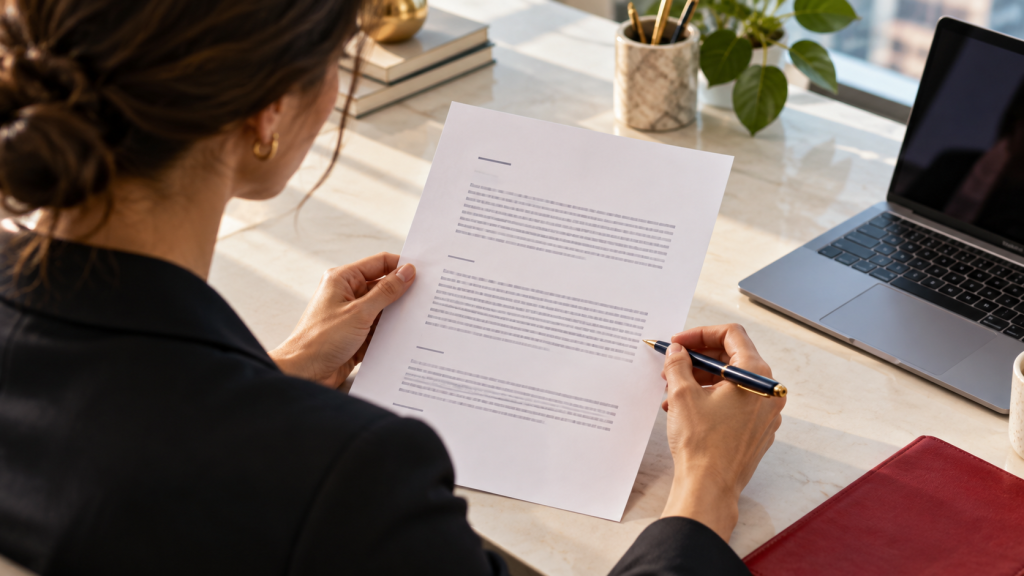
A short cover letter earns attention by making your fit for a vacancy easy to understand. Name the role, show one relevant example, explain the connection, and close with a clear next step. Instead, use plain language and select the experience that matters.
Imagine a recruiter opening an application for a document controller. “I am hardworking and seek a challenging opportunity” gives little evidence. By contrast, a sentence about maintaining a drawing register and checking revision numbers tells the reader something useful about the applicant's preparation.
This guide shows how to write, tailor, and shorten your letter. It includes complete fictional samples and an editing method you can use with your own facts. A clear letter can support your application, but it cannot guarantee an interview.
Quick structure: role and reference → relevant evidence → connection to the vacancy → next step. As a starting point, aim for three short paragraphs and roughly 120–200 words, unless the employer asks for a different length.
What Makes a Short Cover Letter Useful?
Useful brevity means removing information the reader does not need while keeping enough evidence to assess you. However, a letter that only says “Please find my CV attached” does not explain your suitability.
First, identify the vacancy. Next, choose one example connected to its requirements. Then explain the link in ordinary language. Finally, say what you have attached or how you would welcome a discussion.
Therefore, use the suggested word range as an editing aid rather than a hiring rule. If an application form asks for a detailed statement against several criteria, answer that prompt. Otherwise, compressing it into a tiny letter could leave important requirements unanswered.
Read the Vacancy Before Writing Your Short Cover Letter
Highlight two or three requirements that matter most. Specifically, look for the work itself: preparing reports, handling enquiries, maintaining records, checking invoices, or supervising a shift. Then select the requirement your experience supports most clearly.
For example, if an administrative role requires records and scheduling, your strongest evidence might be maintaining a service log and coordinating appointments. By contrast, a general claim about being ambitious gives the reader less useful information.
- What exact role and reference should appear in the opening?
- Which requirement can I support with a real example?
- What did I personally do?
- How does that task connect to the advertised work?
- What documents and submission method does the employer request?
Then, keep the answers beside you as you draft. This makes tailoring quicker without relying on a generic letter.
Short Cover Letter Structure: Three Focused Paragraphs
Open your short cover letter with the role
State what you are applying for and give a relevant starting point. For example, a useful opening is: “I am applying for the Document Controller position, reference DC-18. My recent work includes maintaining drawing registers and checking document revisions.”
Instead, avoid spending several opening lines on enthusiasm alone. Although interest belongs in the letter, the reader should not have to search for the job title.
Support your short cover letter with evidence
Use the middle paragraph for one task, result, or project. Instead of listing every responsibility, explain your own contribution. In addition, any number you use should come from your actual records or knowledge.
For instance: “In my current role, I update the drawing register, check incoming files against revision records, and flag missing approvals before issuing documents.” This is concrete without inventing a percentage improvement.
Close your short cover letter with a next step
Connect your evidence to the vacancy, identify the attachment, and thank the reader. “These duties match your requirement for accurate document tracking. My CV is attached, and I would welcome an opportunity to discuss the role.”
Be confident about what you can support. However, avoid predicting that you will be the best applicant or deliver results you cannot yet know.
Complete Short Cover Letter Example
This example uses a fictional applicant, employer, and work history. Before using the structure, replace the facts with your own.
Dear Hiring Manager,
I am applying for the Document Controller position at Harbour Projects, reference DC-18. I have three years of experience maintaining project records and supporting document submissions.
In my current role, I update drawing registers, check incoming documents against revision records, and flag missing approvals before issuing files. I also coordinate with the site team when a document needs clarification. These duties match your vacancy's focus on accurate tracking and clear communication.
I would welcome the opportunity to support your project team and learn your document procedures. My CV is attached with further details of my experience. Thank you for considering my application; I would be pleased to discuss the role.
Kind regards,
Applicant Name
Phone number | Professional email
Why this short cover letter works
The opening identifies the role and background. Meanwhile, the middle shows relevant actions rather than unsupported strengths. Finally, the closing gives a next step without repeating the CV.
If your experience is limited, replace the work example with relevant training, volunteering, or a project. Label the activity honestly and describe what you actually did.
Short Cover Letter Example With No Work Experience
A first-job application can be brief without sounding empty. First, describe your practical preparation; then explain how it relates to the vacancy.
Dear Recruitment Team,
I am applying for the Junior Accounts Assistant role. I recently completed an accounting diploma, with practical coursework in Excel and invoice records.
For a course project, I prepared a register of sample invoices, checked the entries against supporting documents, and corrected details that did not match. This helped me practise careful checking and keep records easy to follow.
Your vacancy's focus on data entry and supporting the accounts team interests me because it would build on those tasks. My CV is attached. I would welcome the chance to discuss my preparation and learn your procedures.
Kind regards,
Applicant Name
Therefore, do not copy this fictional coursework as your own experience. For a fuller first-job approach, read how to write a cover letter with no work experience.
Short Cover Letter Editing: Turn Claims Into Evidence
| Weak wording | More useful wording | What improves |
|---|---|---|
| I am a hardworking professional seeking a challenging role. | I am applying for your office assistant role; my recent work includes service records and appointment scheduling. | The reader sees the role and relevant work. |
| I have excellent communication skills. | I answered customer enquiries and recorded unresolved requests for the supervisor. | The skill is supported by an action. |
| I am very good at Excel. | I used Excel to maintain an order register and check totals before preparing a weekly summary. | The tool is connected to a task. |
| I am passionate about your esteemed company. | The vacancy's focus on service coordination matches the scheduling work I want to develop. | The interest relates to the advertised work. |
These are writing examples rather than claims you should adopt. Therefore, choose wording that describes your real work and that you can explain at an interview.
What to Remove From a Short Cover Letter
Cut repetition before cutting evidence. For example, remove a long opening about looking for employment if the role is already named. Likewise, remove education and job details that the CV already explains unless you are connecting them to a requirement.
- General praise that could fit any employer.
- A complete list of previous jobs.
- Several unsupported soft-skill claims.
- Repeated sentences about being eager or hardworking.
- Personal details unrelated to the application.
- A long explanation of why you left previous employers.
- Promises of guaranteed performance.
Above all, keep the strongest relevant example. However, a shorter letter loses value if it no longer shows why you fit. Our cover letter versus CV guide explains how to give the documents different purposes.
How to Tailor a Short Cover Letter Quickly
Keep a bank of real examples, then choose the one that fits the vacancy. In other words, reuse your evidence while adapting the paragraph to each employer.
Change the short cover letter opening
Update the role, employer, reference, and relevant background. Finally, check for an old company name before sending.
Select one relevant short cover letter example
For a scheduling role, use coordination evidence. For a record-checking role, use a checking task. If an example does not support the requirements, choose another rather than forcing a connection.
Check the employer connection
Use a detail from the vacancy or the employer's official information. Do not invent familiarity with the company's culture. In most cases, one accurate sentence is enough.
This approach saves time while keeping the application specific. However, it still requires a final read against the current advert.
Short Cover Letter by Email, Upload, or WhatsApp
Using a short cover letter in an email
If the employer accepts an email introduction, paste your short letter into the body and attach the CV. Also, use a clear subject such as “Application for Document Controller — Applicant Name — DC-18.”
If separate documents are requested, attach the letter and CV, then keep the email brief. Otherwise, avoid repeating the whole letter in both places.
Uploading a short cover letter
Follow the accepted file type. Use readable text, ordinary fonts, and a clear filename such as Applicant-Name-Cover-Letter.pdf. After exporting, open the file to check its spacing and completeness.
Writing a short application message on WhatsApp
Use WhatsApp only when the hiring process invites it. For example, an introductory chat can be shorter than a formal letter: name yourself, the role, one relevant fact, and the request or attachment. See professional WhatsApp messages to recruiters for examples.
Check Your Short Cover Letter Before Sending
- Does the opening name the exact vacancy?
- Is the employer name correct?
- Does one real example support a requirement?
- Is my own contribution clear?
- Do dates and qualifications agree with my CV?
- Have I removed repetition and template leftovers?
- Have I followed the requested length and format?
- Are the correct attachments included?
- Can I discuss each statement at an interview?
For an additional review method, consult Stanford Career Education's cover letter resources, including its worksheet and review checklist. Use them to review structure; keep the facts and examples your own.
Short Cover Letter: Frequently Asked Questions
Is a short cover letter unprofessional?
No. A concise letter can be professional when it follows the instructions and contains relevant evidence. However, one vague sentence may leave the reader without enough information to assess your fit.
How short should a short cover letter be?
Three short paragraphs and roughly 120–200 words can be a useful starting point. Treat this as writing guidance, not a fixed rule. Answer any specific application questions or word limits the employer gives.
Should I include several achievements?
Choose the strongest relevant example first. Add another only if it proves a different requirement and fits without crowding the letter. Do not use unverified numbers to make the message look stronger.
Can a short cover letter get me an interview?
It may help the reader understand your application, but it cannot guarantee an interview. Selection also depends on the requirements, competing applications, and the employer's decision.
Can I use an AI tool to shorten my letter?
Yes. Provide your own draft and ask the tool to remove repetition while preserving the facts. Afterwards, check that it has not changed your responsibilities or added unsupported claims.
What if the advert says CV only?
Follow that instruction. A brief email introducing the requested CV may be enough. Do not add an unsolicited separate letter simply because a template recommends one.
Prepare Your Next Application
RESUME TOOLS
Build a Clear Resume
Organise your education, practical activities, and relevant skills in a readable format. Update the details to match the job.
Build my resumeResume TemplatesChoose a professional layout.Resume ExamplesReview structure and wording ideas.Resume EditorUpdate your CV before you apply.INTERVIEW PRACTICE
Practise Your Interview
Practise examples about coursework, volunteering, and personal projects. Be clear about your own actions and what you learned.
Explore Mock InterviewStart live interview practicePractise answering role-related questions.Read interview preparation tipsPrepare clear answers using your own experience.COVER LETTER TOOLS
Write Your Cover Letter
Create a tailored draft from honest notes. Check the employer name, requirements, and every example before sending.
Build my cover letterCover Letter TemplatesChoose a clear structure.Cover Letter ExamplesFind ideas to adapt to your own background.CAREER DEVELOPMENT
Develop Your Skills
Explore training that supports your target role, then compare suitable vacancies and their requirements.
Explore career trainingResignation LetterPrepare a draft for a later career move.Gratuity CalculatorEstimate benefits and check the applicable rules.A short cover letter works best when every sentence helps the reader understand your fit. To achieve this, keep the role clear, choose honest evidence, and make the next step easy to see. Then send the application through the requested channel.
Content note: Prepared with AI assistance. Examples are fictional and intended for adaptation. No letter format guarantees a recruiter response or interview.
Related articles

How to Answer “Why Should We Hire You?” With Real Examples
Learn how to answer 'Why should we hire you?' with a practical three-part formula, 12 realistic role-specific examples…
By Gulf Career Group · 21 min read
How to Improve English Speaking Confidence for Job Interviews
Improve English speaking confidence for job interviews with practical speaking exercises, truthful sample answers, workplace vocabulary, and a…
By Gulf Career Group · 20 min read
How to Handle Questions When You Don’t Know the Answer in an Interview
Don't know the answer in an interview? Learn what to say, when to ask for clarification, and how…
By Gulf Career Group · 18 min read
STAR Interview Method Explained: 15 Questions with Sample Answers
Learn the STAR interview method with 15 fictional sample answers for teamwork, problem-solving, accounting, IT and more. Practise…
By Gulf Career Group · 24 min read