
Working Hours, Overtime and Leave Rules in Saudi Arabia
Understanding working hours in Saudi Arabia is important before accepting a job or signing an employment contract. The written schedule affects your weekly routine, overtime, Ramadan shifts, rest periods, annual leave and final dues. In addition, company policy can provide benefits above the legal minimum. Therefore, workers should separate statutory rights from extra contractual benefits.
This guide focuses on employees covered by the general Saudi Labour Law. Domestic workers and some special categories can be subject to separate rules. Therefore, check the relevant official regulation if your occupation has a special regime. Do not assume every rule below applies in exactly the same way.

Working Hours in Saudi Arabia: Key Facts
- General limit: 8 actual hours per day or 48 per week.
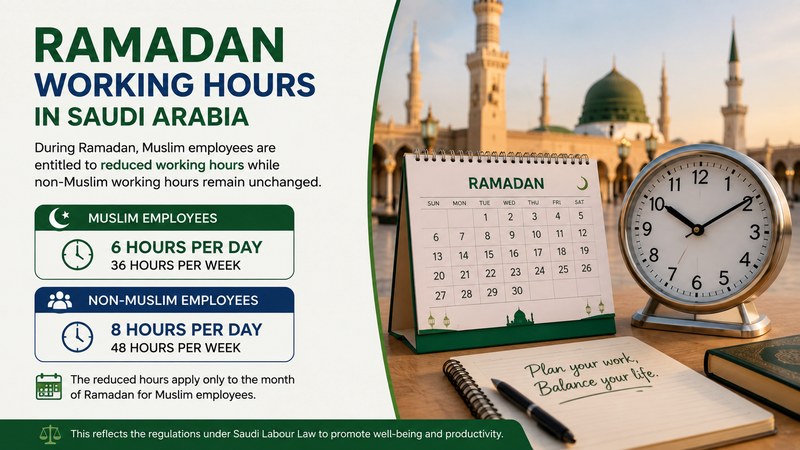
- For Muslim workers during Ramadan: up to 6 hours per day or 36 per week.
- Overtime: actual hourly wage plus 50% of the basic hourly wage.
- Annual leave: at least 21 days, rising to at least 30 days after five consecutive years with the same employer.
- Sick leave: 30 days full pay, 60 days at three-quarters pay, then 30 days without pay within the applicable one-year period.
Standard Working Hours in Saudi Arabia
For working hours in Saudi Arabia, the general daily limit is eight actual hours. When an employer uses the weekly standard, the general limit is forty-eight actual hours per week. However, the law allows specific exceptions. For example, some categories or non-continuous work may reach nine hours per day. The relevant ministerial decision may reduce hazardous or harmful work to seven hours.
Daily and Weekly Working-Hour Limits
Shift-based establishments may also use an approved arrangement in which daily or weekly hours vary. However, they must maintain the required average over the permitted averaging period. Consequently, a company schedule may look different from a simple eight-hour day. Even so, it must comply with the applicable legal framework.
| Item | General Rule |
|---|---|
| Daily working hours | Up to 8 actual hours under the general daily standard. |
| Weekly working hours | Up to 48 actual hours under the general weekly standard. |
| Weekly rest | At least 24 consecutive hours with full pay; Friday is the general rest day, although another day may be substituted for some workers after the required notification. |
| Ramadan hours | For Muslim workers: up to 6 actual hours per day or 36 per week. |
| Rest breaks | No more than 5 consecutive hours without a break of at least 30 minutes for rest, prayer and meals under the general rule. |
Working Hours in Saudi Arabia During Ramadan
The Ramadan rules for working hours in Saudi Arabia reduce actual working time for Muslim workers. The statutory ceiling is six hours per day or thirty-six hours per week. Therefore, the Ramadan limit is not a universal six-hour rule for every worker. Religion and legal category can affect which rule applies.
Employers may organize shorter shifts, staggered starts or different office hours. In practice, a company can set a schedule that is below the legal maximum. However, a covered employee may work beyond the applicable normal hours. If that work qualifies as overtime, the overtime provisions can still apply.
Rest Breaks During the Working Day
The rules on working hours in Saudi Arabia also protect break time. Employers should not schedule more than five consecutive working hours without a break for rest, prayer and meals. Each such break must be at least thirty minutes under the general rule. In addition, the general framework limits how long a worker remains at the workplace. The period should not exceed twelve hours in one day.
The law does not count these rest, prayer and meal periods as actual working hours. During them, the employer does not control the worker. Therefore, an employer should not require the employee to remain at the workplace during a statutory break. Specific continuous-work exceptions may apply when the competent authority permits them.
Weekly Rest Days
Weekly rest is part of the wider framework for working hours in Saudi Arabia. Therefore, the schedule should clearly show both workdays and the designated rest period.
The general Saudi Labour Law provides a weekly rest period with full pay of at least twenty-four hours in a row. Friday is the general weekly rest day. However, an employer may substitute another day for some workers after the required notification. The employer must also enable workers to perform their religious obligations.
As a result, not every employee in Saudi Arabia has the same weekday off. Continuous operations, shift work and remote-work arrangements can have special rules. If an employee works on a designated weekly rest day, the employer should review the applicable overtime rules. The employer should also check any substitute-rest requirement instead of treating it as an ordinary day.
Overtime and Working Hours in Saudi Arabia
Overtime in Saudi Arabia generally covers work beyond the adopted normal working-hour standard. Working hours in Saudi Arabia may use a weekly standard. In that case, the law treats hours above the adopted weekly standard as overtime. In addition, all working hours performed during official holidays and vacations are considered overtime hours under Article 107.
Overtime Limits and Exceptions
Saudi rules also provide specific exceptions for unusual work pressure, emergencies, seasonal work and other situations. In those exceptional cases, the law sets a further ceiling. Actual work must not exceed ten hours per day or sixty hours per week. Furthermore, HRSD guidance sets a 720-hour annual limit for additional working hours. The worker may agree to exceed that number.
The rules reviewed here do not create a general legal “night premium” simply because overtime occurs at night. Nevertheless, a contract, workplace regulation or sector-specific rule may provide more favourable compensation. Therefore, workers should check both the law and their written employment terms.

How Overtime Pay Is Calculated
For overtime linked to working hours in Saudi Arabia, the current HRSD awareness guide uses two wage bases. Payroll teams should distinguish between them. First, calculate the employee's hourly rate from the actual wage. Next, add fifty percent of the basic hourly wage. This matters because the overtime formula is not simply “150% of every salary component.”
Overtime formula
Overtime hourly pay = Actual hourly wage + (50% × Basic hourly wage)For a monthly-paid employee, the current HRSD awareness guide illustrates hourly conversion using monthly wage ÷ 30 days ÷ 8 hours.
Basic monthly wage: SAR 5,000
Actual monthly wage: SAR 7,000
Actual hourly wage: 7,000 ÷ 30 ÷ 8 = SAR 29.17
Basic hourly wage: 5,000 ÷ 30 ÷ 8 = SAR 20.83
50% of basic hourly wage: SAR 10.42
Overtime hourly amount: 29.17 + 10.42 = SAR 39.59
For 10 overtime hours: approximately SAR 395.90
Actual payroll can depend on which components qualify as actual wage or basic wage. The employment contract and workplace regulations can also matter. Therefore, employees should compare the payroll basis with HRSD definitions. They should not assume every allowance receives the same treatment.
Example Monthly Overtime Calculation
Suppose an employee has a basic monthly wage of SAR 5,500. The employee's actual monthly wage is SAR 8,000. During one month, the employee completes 18 approved overtime hours.
- Actual hourly wage = 8,000 ÷ 30 ÷ 8 = SAR 33.33.
- Basic hourly wage = 5,500 ÷ 30 ÷ 8 = SAR 22.92.
- 50% of basic hourly wage = SAR 11.46.
- Overtime hourly amount = 33.33 + 11.46 = SAR 44.79.
- Monthly overtime = 44.79 × 18 = approximately SAR 806.25.
In addition, the amended rules allow paid compensatory leave instead of overtime pay when the worker agrees. HRSD guidance sets conditions for compensatory leave. These include the applicable minimum leave conversion and timing rules.
Annual Leave in Saudi Arabia
Annual leave is separate from daily working hours in Saudi Arabia. However, the written employment terms and workplace procedures should explain both clearly.
The general Saudi Labour Law gives covered employees at least twenty-one days of paid annual leave each year. After five consecutive years with the same employer, the minimum increases to thirty days. The employer pays the annual-leave wage in advance.
Scheduling and Carrying Annual Leave Forward
The employer may schedule leave according to work requirements. However, the employee must receive at least thirty days' notice of the scheduled leave date. In addition, a worker may postpone annual leave to the following year with employer approval. The employer may postpone leave for up to ninety days after the entitlement year when work requires it. A longer postponement requires the worker's written consent. It cannot extend beyond the end of the following year.
| Annual Leave Point | What the Rule Means |
|---|---|
| Minimum entitlement | At least 21 paid days per year. |
| After 5 consecutive years | At least 30 paid days per year with the same employer. |
| Leave pay | Paid in advance. |
| Scheduling | Employer may schedule according to work needs, with at least 30 days' notice. |
| Carrying forward | Possible with employer approval; statutory postponement limits apply. |
| Cash during employment | The worker may not waive annual leave in exchange for cash while still employed. |
| Employment ends | Accrued unused leave must be paid, including proportional entitlement for part of the final year. |

Sick Leave Rules
Employees reviewing working hours in Saudi Arabia should also understand certified sick leave. It can affect attendance records, payroll and scheduled shifts.
A worker who proves illness can take sick leave during the applicable one-year period. The leave days may be continuous or intermittent. That one-year period starts from the date of the first sick leave. In practice, employees should follow the employer's reporting process and provide medical evidence from an accepted medical authority when required.
| Sick Leave Period | Pay Treatment |
|---|---|
| First 30 days | Full pay. |
| Next 60 days | Three-quarters pay. |
| Following 30 days | Without pay. |
Therefore, workers should not confuse a company's short medical-leave policy with the complete statutory sick-leave structure. Likewise, employers should maintain accurate records because the relevant days may be spread across the year.
Public Holidays in Saudi Arabia
Public holidays also affect working hours in Saudi Arabia. Covered employees receive paid leave for the official holidays and occasions specified by the regulations. Current HRSD guidance lists Eid al-Fitr, Eid al-Adha, National Day and Founding Day.
- Eid al-Fitr: 4 days, beginning the day after the 29th of Ramadan under the Umm al-Qura calendar.
- Eid al-Adha: 4 days, beginning on the Day of Arafah.
- Saudi National Day: 1 day.
- Saudi Founding Day: 1 day on 22 February.
Islamic-calendar dates move in the Gregorian calendar, so workers should check the official announcement for the relevant year. If an employee works during an official holiday, Article 107 treats those working hours as overtime.
Maternity Leave
Recent Saudi Labour Law amendments changed maternity leave. A working woman is entitled to 12 weeks of fully paid maternity leave. The worker must take six weeks after childbirth. She may distribute the remaining six weeks as permitted, including up to four weeks before the expected delivery date. An approved medical certificate supports that expected date.
If delayed childbirth reduces the remaining leave below six weeks, the completing period is treated as unpaid leave. In all cases, the worker may extend maternity leave by one month without pay. In addition, a woman who gives birth to a sick child or a child with special needs may receive extra leave when continuous accompaniment is required. The law provides one extra month with full pay after maternity leave. She may then extend it by another month without pay.
Paternity Leave
A worker receives three days of fully paid paternity leave following the birth of a child. The worker must take those days within seven days from the date of birth. The employer may request supporting documentation. Therefore, employees should inform HR promptly rather than waiting until the entitlement window has passed.
Marriage Leave
A worker is entitled to five days of fully paid leave upon marriage. The leave is calculated from the date of the event, and the employer may request proof. A company may grant more than five days. However, extra days come from the contract or company policy rather than the general statutory minimum described here.
Bereavement Leave
A worker receives five days of fully paid leave upon the death of a spouse, an ascendant or a descendant. In addition, the current law provides three days of paid leave for the death of a brother or sister. These leaves are calculated from the date of the event, and supporting documents may be requested.
There are separate rules for a woman whose husband dies. A Muslim female worker receives fully paid 'Iddah leave of at least four months and ten days from the date of death. The law also allows the specified unpaid extension when pregnancy applies. A non-Muslim female worker is entitled to fifteen days of fully paid leave.
Hajj Leave
A worker who has not previously performed Hajj may receive paid Hajj leave once during the entire period of service. The leave must be at least ten days and no more than fifteen days, including the Eid al-Adha holiday. However, eligibility requires at least two consecutive years of service with the employer.
The employer may decide how many workers receive Hajj leave in a year based on work requirements. Therefore, an eligible employee should request it early and follow the employer's documented approval process.
Examination or Study Leave
When an employer approves enrolment or continued enrolment, the employee can receive fully paid examination leave for a non-repeated academic year. The leave covers the actual examination days. A repeated academic year, however, makes the examination leave unpaid.
Without prior employer approval for enrolment, the examination days come from available annual leave. If no annual leave remains, the examination leave is unpaid. The employee must submit the request at least fifteen days in advance. The employer may also request proof of the examinations.
Unpaid Leave
An employee may take unpaid leave with the employer's consent for a period agreed by both parties. If unpaid leave exceeds twenty days, the law treats the excess period as a contract suspension. The parties may agree otherwise.
Because unpaid leave can affect continuity and other contractual calculations, written approval is important. Therefore, employees should keep a copy of the request, approval, dates and any agreement about service treatment.
What Happens to Unused Leave When Employment Ends?
Unused annual leave remains relevant whether an employee resigns, a fixed-term contract expires or employment ends another way. The worker receives wages for accrued annual-leave days that were not taken. The worker is also entitled to proportional leave pay for the fraction of the final year worked.
Working Hours in Saudi Arabia for Expats
When comparing offers, expatriates should check the stated working hours in Saudi Arabia. The hours should match the contract, shift roster and overtime clause.
Saudi employment rules generally govern working hours for expats in Saudi Arabia. The same framework applies to other covered workers unless a specific rule says otherwise. However, a foreign employee's written contract may include additional benefits such as flights, accommodation, transport or extra leave. Those benefits are not automatically guaranteed to every expatriate unless required by law or included in the binding employment terms.
Before accepting an offer, an expatriate should check the working schedule, overtime clause, weekly rest day and annual leave. The review should also cover salary structure, probation, contract duration and termination terms. In addition, verify any airfare, housing or transport promise in writing. For immigration requirements, review the Saudi Arabia work visa requirements guide.
Employee Checklist Before Signing a Saudi Employment Contract
- Confirm normal daily and weekly working hours.
- Confirm the number of working days each week.
- Check the overtime formula and approval process.
- Identify the weekly rest day and shift pattern.
- Confirm annual-leave days and scheduling procedure.
- Check sick-leave reporting and medical-document rules.
- Confirm treatment of official public holidays.
- Separate basic wage from allowances and total actual wage.
- Review probation length and conditions.
- Read termination, notice and resignation clauses.
- Check end-of-service treatment and final settlement terms.
- Verify any housing, transport, flight or other extra benefit in writing.
Employer Responsibilities
Employers should organize working hours in Saudi Arabia, breaks, weekly rest and overtime in accordance with the applicable rules. In addition, payroll and attendance records should clearly support how ordinary hours and overtime were calculated. Accurate leave records are equally important because annual leave, sick leave and special leave may affect payroll and final settlement.
Employers should also issue and maintain employment terms that accurately reflect the worker's agreed wage, work arrangements and benefits. Therefore, lawful payroll practice requires more than simply paying the monthly salary. Records should also support overtime, leave, deductions and final dues.
Common Mistakes Employees Should Avoid
- Relying on verbal promises about overtime, leave or flight benefits.
- Not reading the overtime clause before signing the contract.
- Failing to keep attendance, shift or overtime approval records.
- Assuming every allowance is automatically part of the basic wage.
- Confusing a generous company policy with the statutory minimum.
- Waiting too long to request Hajj, examination or other planned leave.
- Signing payroll, leave or settlement documents that are not understood.
- Assuming domestic-worker regulations are identical to the general Labour Law.
Quick Summary Table
This table brings the main working hours in Saudi Arabia, overtime and statutory leave points into one quick reference.
| Employment Rule | What Workers Should Know |
|---|---|
| Normal working hours | General ceiling: 8 actual hours/day or 48/week. |
| Ramadan working hours | For Muslim workers: up to 6 actual hours/day or 36/week. |
| Overtime | Actual hourly wage + 50% of basic hourly wage; official-holiday work counts as overtime. |
| Weekly rest | At least 24 consecutive paid hours; Friday is general, with permitted substitution. |
| Annual leave | At least 21 days; at least 30 after 5 consecutive years with the same employer. |
| Sick leave | 30 days full pay + 60 days at 75% pay + 30 days unpaid. |
| Public holidays | Eid al-Fitr, Eid al-Adha, National Day and Founding Day under current guidance. |
| Maternity leave | 12 weeks fully paid, with 6 post-birth weeks mandatory. |
| Paternity leave | 3 paid days within 7 days of birth. |
| Marriage leave | 5 paid days. |
| Bereavement leave | 5 days for spouse/ascendant/descendant; 3 days for sibling, plus separate widow provisions. |
Frequently Asked Questions About Working Hours and Leave in Saudi Arabia
How many hours can an employee work per day in Saudi Arabia?
For working hours in Saudi Arabia, the general daily limit is eight actual working hours when the daily standard applies. However, certain work categories and lawful exceptions can have different limits.
What are the normal weekly working hours in Saudi Arabia?
Under the general rule for working hours in Saudi Arabia, the weekly limit is forty-eight actual hours. Lawful exceptions and approved arrangements can modify how the schedule operates.
Are working hours reduced during Ramadan?
Yes. Ramadan rules reduce working hours in Saudi Arabia for Muslim workers covered by the general rule. The limit is no more than six actual hours per day or thirty-six hours per week.
How is overtime calculated in Saudi Arabia?
HRSD guidance uses the actual hourly wage plus fifty percent of the basic hourly wage. Therefore, the correct calculation may use more than one wage figure.
Is overtime compulsory in Saudi Arabia?
An employer may lawfully require overtime in applicable circumstances, but statutory limits, compensation rules and exceptions still apply. Employees should also review their contract and internal work regulations.
How much annual leave do employees receive?
The minimum is twenty-one paid days per year, increasing to thirty paid days after five consecutive years with the same employer.
How does sick leave work in Saudi Arabia?
Within the relevant one-year period, a worker with proven illness receives thirty days at full pay. The next sixty days are at three-quarters pay, followed by thirty days without pay.
Are expatriate workers entitled to Saudi public holidays?
Foreign workers covered by the general Saudi Labour Law generally receive the statutory paid holidays that apply to covered workers. Their contracts may also provide extra benefits.
What happens to unused annual leave when I resign?
When employment ends, the worker receives payment for accrued unused annual-leave days. The final settlement also includes the proportional entitlement for the fraction of the final year worked.
Can an employer refuse annual leave?
An employer can schedule and lawfully postpone annual leave within the statutory rules, but cannot permanently remove the worker's legal annual-leave entitlement.
Related Gulf Career Group Guides
Readers researching working hours in Saudi Arabia may also need wider job context. These Gulf Career Group guides cover visa, job-market and cost topics.
- Saudi Arabia work visa requirements and application process
- Most in-demand Saudi expat careers
- Guide to Saudi jobs for foreign workers
- Where to find Saudi Arabia job vacancies
- Cost of living in Saudi Arabia for expat workers
- Browse current Gulf job listings
Sources and Legal References
Methodology: We cross-checked the numerical rules against current Ministry of Human Resources and Social Development pages. We also reviewed HRSD's recent employer and worker rights awareness material. Where company policy can be more generous than the statutory minimum, the article states that distinction.
- Saudi Ministry of Human Resources and Social Development — Working Conditions and Labour Law articles
- Employer and worker rights awareness guide (HRSD)
- Women employment, maternity and widow leave provisions (HRSD)
- Health and safety in the work environment (HRSD)
Conclusion
Understanding working hours in Saudi Arabia helps employees compare a job offer with the legal framework before problems arise. The general rules cover daily and weekly hours, shorter Ramadan hours for Muslim workers, rest breaks and weekly rest. They also cover overtime compensation. In addition, workers should understand annual leave, sick leave and official holidays. Special leave can include maternity, paternity, marriage, bereavement and Hajj leave.
What Employees Should Check
The statutory minimum is only part of the employment package. A company may provide extra leave, higher overtime benefits, flights, housing or transport. However, the contract or workplace rules should state those additional benefits clearly. Therefore, read the contract carefully and keep attendance and leave records. Also, verify current requirements through official Saudi sources before making an important employment decision.
YOAST / EDITOR CHECKLIST SEO title: Working Hours in Saudi Arabia: Overtime & Leave Rules URL slug: working-hours-overtime-leave-saudi-arabia Meta description: Learn working hours in Saudi Arabia, overtime pay, Ramadan schedules, annual leave, sick leave and key employee rights under Saudi labour rules. Focus keyphrase: working hours in Saudi Arabia Canonical: https://gulfcareergroup.com/career-advice/working-hours-overtime-leave-saudi-arabia/ Robots: index, follow One H1: yes Focus keyphrase in SEO title/meta/intro/H2/body/conclusion/image ALT: yes Visible images with descriptive ALT text: yes (upload files to the exact URLs used before publishing) Responsive tables and images: yes Internal links: verified live Gulf Career Group URLs used FAQ visible and matched to FAQ schema: yes Breadcrumb items use absolute URLs: yes OG/Twitter image: 1200x675 No visible placeholder image URLs: yes Note: If Yoast already outputs Article, Breadcrumb or FAQ schema, remove overlapping custom schema nodes to avoid duplicate entities.Related articles

How to Answer “Why Should We Hire You?” With Real Examples
Learn how to answer 'Why should we hire you?' with a practical three-part formula, 12 realistic role-specific examples…
By Gulf Career Group · 21 min read
How to Improve English Speaking Confidence for Job Interviews
Improve English speaking confidence for job interviews with practical speaking exercises, truthful sample answers, workplace vocabulary, and a…
By Gulf Career Group · 20 min read
How to Handle Questions When You Don’t Know the Answer in an Interview
Don't know the answer in an interview? Learn what to say, when to ask for clarification, and how…
By Gulf Career Group · 18 min read
STAR Interview Method Explained: 15 Questions with Sample Answers
Learn the STAR interview method with 15 fictional sample answers for teamwork, problem-solving, accounting, IT and more. Practise…
By Gulf Career Group · 24 min read